D
H
M
S
Offer
Provide additional details about the offer you're running
FLASHSALE


Hi neurodivergent besties! I have been thinking about this a lot lately and it seemed like something to both bring to you all on and also process myself, so I want to start this post with a questions: When was the last time you did something simply because it was fun?
Not because it was productive.
Not because it was good for your mental health.
Not because you could turn it into a hobby, a side hustle, or something to check off your list.
Just because you wanted to.
For many women with ADHD, this question can be surprisingly difficult to answer, because we become very good at doing, managing, remembering, planning, catching up, and trying to keep everything together.
And somewhere along the way, play can quietly disappear as our energy and brain power/spoons for the day shift to managing instead of being.
For many women, especially those diagnosed with ADHD later in life, productivity can become tangled up with self-worth as we process the lifetime we spent always feeling like we were falling behind.
Many of us hold the shame that we are lazy, scattered, forgetful, or inconsistent. Over-productivity can mask that when we learn to compensate for our shortcomings by working harder, being more organized, more prepared, and more responsible. Those are the very things that dim our ability to connect with joy and play.
So when you finally have an hour to yourself, your first thought might not be:
“What sounds fun?”
It might be:
“What should I get done?”
The laundry.
The emails.
The dishes.
The errand you’ve been putting off.
Even our hobbies can become another opportunity to perform, because we want to be good at them…duh. We want to finish them and justify the time and money we’re spending.
And suddenly, something that was supposed to bring us joy becomes another item on the list.
I think there is something powerful about doing something that has no measurable outcome.
Coloring without making something beautiful.
Digging in the dirt.
Building something with your hands.
Reading a novel in the middle of the afternoon.
Buying the markers because you like the colors.
Taking a walk and noticing things along the way.
Making something badly.
Trying something once and never doing it again.
There is freedom in doing something that doesn’t need to become anything.
Play gives us permission to be curious instead of competent and for those of us who have spent years trying to prove that we are capable, that can be a radical shift.
Sometimes I wonder if neurodivergent women actually grow out of play or if we simply become too busy surviving.
Maybe you stopped drawing because there were more important things to do, stopped dancing because you became self-conscious, or stopped rying new things because being bad at something felt uncomfortable.
Maybe you learned that being responsible was more valuable than being curious. Maybe you were praised for being helpful, successful, or accomplished, but rarely for simply being delighted.
And maybe your younger self is still there, still curious, still creative, still wanting to play.
When we talk about ADHD support, we often talk about executive functioning, routines, organization, time management, and getting things done.
Those things can be incredibly helpful, but I personally don’t believe our healing is about becoming better at functioning.
I want there to be room for becoming more alive, too and to come home to the person we have always been.
For joy.
For curiosity.
For creativity.
For spontaneity.
For doing things that don’t make you more productive but make you feel more like yourself, because your life is more than the things you accomplish.
So consider this your permission slip…
You are allowed to have hobbies that don’t become businesses.
You are allowed to start something and abandon it.
You are allowed to be bad at something.
You are allowed to spend money on art supplies without becoming an artist.
You are allowed to rest before everything is finished.
You are allowed to do something simply because it makes you happy.
You don’t have to earn joy.
This week, pause and try something different. Ask yourself: “What sounds fun?”
And if you don’t know the answer, that’s okay…start smaller.
You don’t have to overhaul your life or became a new person, maybe you just buy the crayons at Target. Maybe you put on your favorite song and notice how it makes your body feel. Maybe you sit outside with your coffee and watch the birds.
Maybe you do absolutely nothing productive for twenty minutes and maybe, slowly, you begin to remember:
You are not here just to keep up with your life. You’re here to experience it and experiencing it means giving yourself permission to play.
This past week, my friend MaryBeth who founded Create Space came to my office and held a workshop about play for the therapists that rent office space for me. It was beautiful to see these women that I know in a clinical sense share openly about what brings them joy and connection to themselves outside of their work and the roles they hold.
I was reminded of how my desire to create art, make messes, rearranging and piddle with things in the house and play in the garden/outside with my chickens is something that I have enjoyed a variation of my whole life.
If you aren’t familiar, with Create Space, MaryBeth offers 10-week cohort based programs for women who want to both connect with themselves and explore hobbies with other women in the Charlotte area. Check her out, because this is truly such a cool offering and while it’s not geared to only neurodivergent women, it is a great opportunity for us!
Want more? Let’s connect!
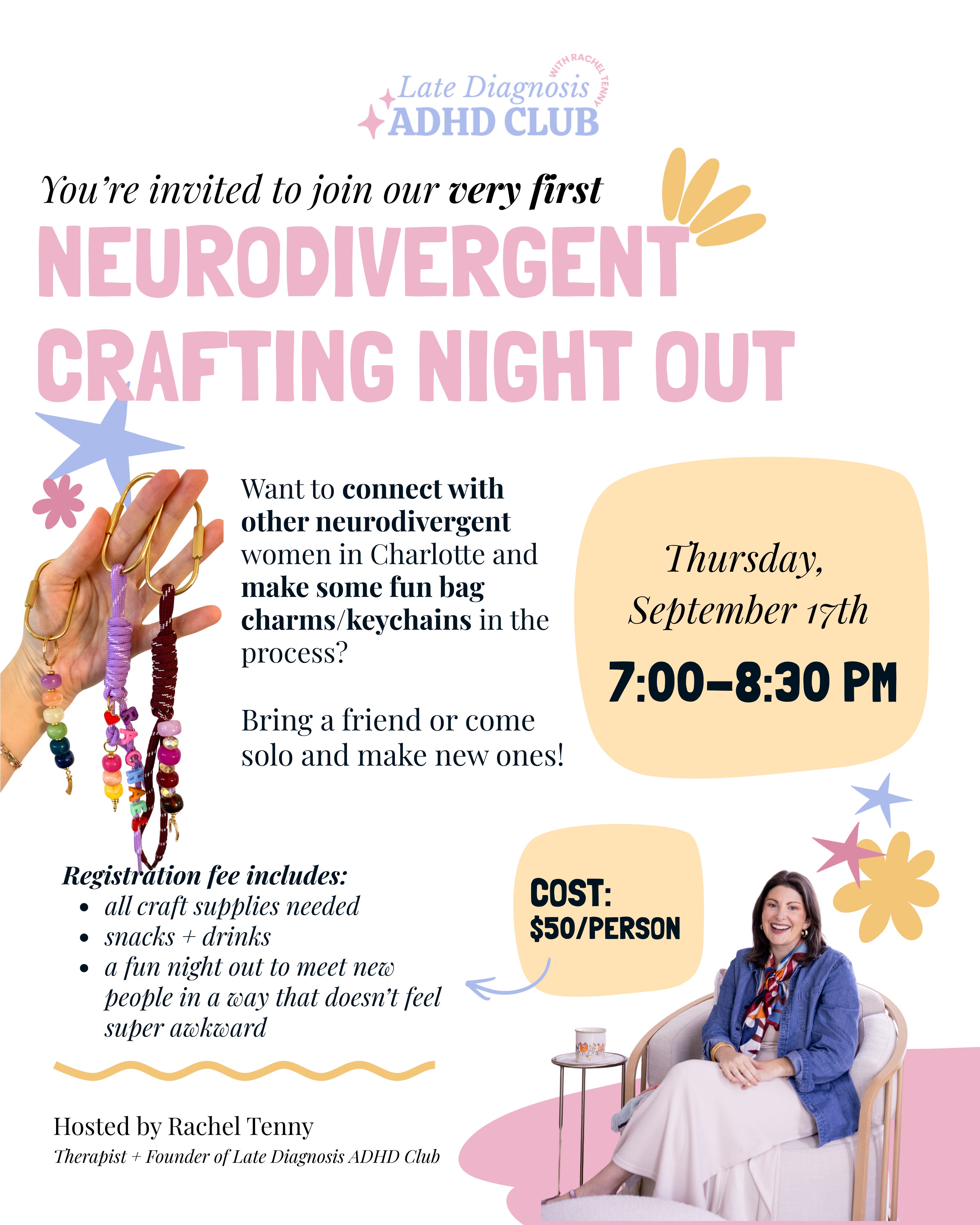
I am so excited to share that I am hosting my VERY FIRST Neurodivergent Crafting Night Out on 9/17. Use code CRAFTY at checkout to save $5 on your ticket!
Join my upcoming group: Chaos to Compassion for women with ADHD . This group is a 6 week program open to participants worldwide. Groups run from 12-1PM EST or 6-7 PM EST via Zoom.
Work with me: I offer virtual counseling in NC and SC as well as ADHD coaching support to those outside of NC & SC.
Email: rachel@racheltenny.com for more information.
Resources for ADHD: I have a library of mental health resources and a section just for ADHD and Women with a Late Diagnosis!
Are you a therapist? I offer supervision and consulting for therapists as well as The Therapist Toolbox Resource Library for other providers.

One of the things I’ve been thinking about lately is how much shame can get wrapped up in needing help, especially when you’re neurodivergent. I will give you bonus points if you’re the oldest daughter… IYKYK.
For so many of us, there is a long history of being told, directly or indirectly, that we should be able to do things that we consistently struggle with. Or we try to overextend to prove that we can do it all and then crash out. Spoiler alert: Nobody does it all. They are lying if they say they do or else they wake up at 3 AM and are in overdrive.
I think this is one of the things that made my ADHD diagnosis (at age 33 after my 2nd daughter was born) so complicated.

What if the way back to yourself isn’t another system, strategy, or productivity hack, but instead learning to trust what you already know? Your intuition. Your knowing. Your power. The things you knew in your bones before you were forced to bury or hide or shrink them.

As a therapist who works primarily with women with a late ADHD diagnosis, I notice a few common themes that most of the neurodivergent I spend time with experience:

When you have ADHD, it can feel like you are never not “managing” yourself. Whether it’s trying to make sure you’re doing enough, showing up in a way that doesn’t show how hard things are, or just trying not to drop the ball. It’s a lot…and your inner critic, well she (he/they) are often sitting on your shoulder making sure you don’t mess up and reminding you of all the times you did in case you get too comfortable.
I like the idea of externalizing our inner critic as “us, but not us”. Our inner critic is a part of us that likely developed to keep us from those moments when we experienced guilt and shame and heartbreak. Even when we try to slow down or take a break, our inner critic is often there, watching and waiting. Like the house guest who won’t go away, because more than anything, they don’t want us to experience failure or hard emotional responses.

There are a lot of things that may be easier than creating a sustainable routine if you have ADHD. ADHD...

When you have ADHD, procrastination is often highly misunderstood. It’s rarely avoidance, laziness, or lack of motivation. Many people with ADHD want to start earlier, but struggle to access the mental energy needed to begin.
The issue is often task initiation, not intention. As I shared a few week’s ago in the post all about Task Initiation, ADHD brains are interest-based. Tasks that feel boring, repetitive, overwhelming, unclear, or emotionally loaded can be hard to start.
Then suddenly, when the deadline gets closer, urgency kicks in and the brain finally starts to activates. Often intensely.

There’s a very specific kind of frustration that comes with ADHD and executive dysfunction.
It’s not just about being distracted or forgetful.
It’s the experience of knowing what needs to be done…and feeling completely unable to follow through.
Not because you don’t care. Not because you’re not trying.
Just… stuck in the gap between intention and action.
From the outside, it can look like laziness, inconsistency, or a lack of discipline.
But internally? It often feels like your brain won’t cooperate with you.

One of the most common things I hear from adults with ADHD, especially women and late-diagnosed folks, isn’t about focus or productivity.
It’s this:
“I feel misunderstood all the time.”
And not in a loud, dramatic way.
In a quiet, accumulating way.
The kind that settles into your nervous system and slowly teaches you not to trust yourself or to minimize your intuition and needs.

Spoon Theory is a metaphor used describe the limited energy people with chronic illness or mental health concerns often have....

Personal reflections as a therapist who received a late ADHD diagnosis.

Rejection sensitivity can make even small moments feel overwhelming. This post explores what it looks like, why it shows up (especially for those with ADHD), and how to work with your brain instead of against it when emotions feel like too much.

Group therapy offers more than just support—it provides connection, perspective, and community. Whether you're navigating a new diagnosis, identity shift, or season of overwhelm, this post explores how group spaces can help you feel seen, supported, and less alone.

For years, I blamed myself for being "scattered" or “bad at adulting.” I thought if I just tried harder, I’d finally get it together. But what I didn’t realize was that I was struggling with executive dysfunction—something that impacts nearly every part of life for people with ADHD. In this blog, I’m sharing my own experience with a late ADHD diagnosis and unpacking why struggles with focus, time, and task initiation aren’t signs of laziness—they’re signs you might need support.
Describe the benefits of your newsletter